Correlation Vs Causation Reading for Middle School Students
In near countries basic education is nowadays perceived non only as a correct, merely also as a duty – governments are typically expected to ensure admission to basic education, while citizens are ofttimes required by law to attain instruction up to a certain bones level.1
This was not always the instance: the advancement of these ideas began in the mid 19th century, when most of today's industrialized countries started expanding chief education, mainly through public finances and government intervention. Data from this early period shows that government funds to finance the expansion of education came from a number of different sources, but specifically taxes at the local level played a crucial role. The historical part of local funding for public schools is of import to aid us understand changes – or persistence– in regional inequalities.
The second half of the 20th century marked the start of educational activity expansion as a global phenomenon. Bachelor information shows that by 1990 government spending on education as a share of national income in many developing countries was already close to the average observed in developed countries.2
This global education expansion in the 20th century resulted in a historical reduction in pedagogy inequality beyond the globe: in the period 1960-2010 teaching inequality went down every yr, for all age groups and in all world regions. Recent estimates of education inequality across historic period groups propose that further reductions in schooling inequality are all the same to be expected within developing countries.3
Contempo cross-country information from UNESCO tells united states that the globe is expanding regime funding for education today, and these additional public funds for education are non necessarily at the expense of other government sectors. Yet backside these broad global trends there is substantial cross-country – and cross-regional – heterogeneity. In high-income countries, for instance, households shoulder a larger share of instruction expenditures at higher education levels than at lower levels – but in low-income countries this is not the case. Republic of malaŵi is a stark example: tertiary education is almost completely subsidised by the land, still household contribute almost xx% of the costs of principal teaching.
Post-obit the understanding of the Millennium Development Goals, the first decade of the 21st century saw an of import increment in international financial flows under the umbrella of development assistance. Recent estimates evidence that development help for education has stopped growing since 2010, with notable aggregate reductions on flows going to principal education. These changes in the priorization of evolution assistance for education beyond levels and regions, can take potentially large distributional effects, particularly inside low income countries that depend essentially on this source of funding for basic education.4
When analysing correlates, determinants and consequences of education consumption, the macro information indicates that national expenditure on education does not explain well cross-land differences in learning outcomes. This is indicative of a complex 'pedagogy production function' whereby for any given level of expenditure, output achieved depends crucially on the input mix.
Available evidence specifically on the importance of school inputs to produce education, suggests that learning outcomes may exist more than sensitive to improvements in the quality of teachers, than to improvements in class sizes. Regarding household inputs, the contempo experimental evidence suggests that interventions that increment the benefits of attending school (east.g. provisional cash transfers) are specially probable to increase student time in school; and that those that incentivise academic effort (eastward.g. scholarships) are likely to ameliorate learning outcomes.
Policy experiments accept too shown that pre-schoolhouse investment in demand-side inputs leads to large positive impacts on education – and other important outcomes afterwards in life. The environment that children are exposed to early in life, plays a crucial part in shaping their abilities, behavior and talents.
All our charts on Financing Education
Historical perspective on financing education
When did the provision of didactics first become a public policy priority?
Governments around the world are nowadays widely perceived to be responsible for ensuring the provision of accessible quality education. This is a recent social accomplishment. The advancement of the thought to provide instruction for more and more than children merely began in the mid 19th century, when virtually of today's industrialized countries started expanding master education. The post-obit visualization, plotting public expenditure on education equally a share of Gross Domestic Product (Gross domestic product) for a number of early-industrialized countries, shows that this expansion took place mainly through public funding.v Our entry on Main Education and Schools provides details regarding how this expansion in funding materialized in amend educational activity outcomes for these countries.
How did the The states finance the expansion of public education?
Public schools in the US currently educate more xc% of all children enrolled in elementary and secondary schools.vi
This is the consequence of a process of education expansion that relied heavily on public funding, particularly from local governments. The visualization shows the sources of revenues for public schools in the US over the last 120 years. As it tin can be seen, states and localities are – and have always been – the chief sources of funding for public chief education in the US. In fact, we notice iii wide periods in this graph: there is first a menstruation of stable revenues until 1920, and so a period of sharp growth and refuse during the interwar years, so a menstruum of substantial growth since the second world war, slowing downwards in the 1970s. In all these periods, federal funding was always very small, equally can exist seen when changing the visualisation from 'absolute' to 'relative'. Disaggregated data from the concluding couple of decades gives further insights into the specific sources of local revenues for schools in the Us: the largest role comes from holding taxes (near fourscore% of local revenues came from holding taxes in 2013), while just a very pocket-size part comes from fees and donations (private funding for public schools, which is considered a local revenue, amounted to less than 2% of total public school revenues in 2013). This heavily decentralised system relying on property taxes has the potential of creating large inequalities in pedagogy, since public schools in flush urban areas are able to raise more than funding from local revenues. Indeed, a significant part of the argue on education inequalities in the U.s.a. today focuses on the importance of increasing progressive federal spending to reduce inequalities in public school funding.7
How did France finance the expansion of public education?
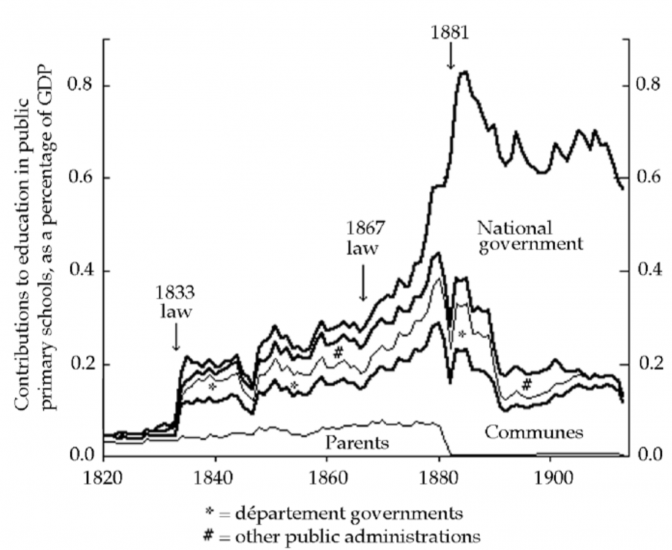
The case of the US in a higher place shows that funding for public schools has been historically a responsibility of local governments. In other countries, such as France, the expansion of public education too took place initially with resources from local governments, but relatively quickly the fiscal brunt was shifted to the national level. In France this transition was associated with a abrupt jump towards universal admission and a concomitant reduction in regional inequalities. The following visualization from Lindert (2004)eight provides evidence of the French feel. As we tin can run into in that location are three distinct periods: educational activity spending was initially low and mainly private, then in 1833 funding began growing with local resource later the introduction of a law liberating communes to raise more local taxes for schools, and finally in 1881 the national government took over about of the financial responsibility later the introduction of a new police that abolished all fees and tuition charges in public elementary schools. In the source book, Lindert (2004) provides further bear witness of how this transition towards centrally funded public didactics reduced north-southward inequalities in France.
Sources of funds for French republic'south public primary schools, 1820–1913 – Figure 5.5 in Lindert (2004)9
In the Usa growth in teaching expenditure was characterized by growth specifically in the public sector
A comparison of expenditure betwixt public and private education institutions is helpful to contextualize the office the public sector played in the process of education expansion in industrialized countries. The following graph does this using information from the National Center for Education Statistics in the Us. It shows that during the years 1950-1970 – a period of substantial growth in instruction expenditure in the US – expenditure grew specifically in the public sector.ten
When did the expansion of basic education become a global phenomenon?
The 2nd half of the 20th century marked the beginning of educational activity expansion equally a global phenomenon. The visualization, using data from Szirmai (2005)11, shows regime expenditure on didactics as a share of national income for a pick of low and middle-income countries, together with the corresponding average for high-income countries, for the period 1960-2010. As it can be seen, by 1990 government spending on education in many developing countries was already close to the boilerplate observed in developed countries.
It is important to point out that the remark above makes reference to convergence in expenditure relative to income. To the extent that low-income countries remain poorer than high-income countries, gaps in levels of expenditure per pupil are persistently large. Indeed, cross-country heterogeneity in education expenditure per pupil is currently much higher than heterogeneity in expenditure every bit share of GDP.12 1 gene contributing to the slower convergence of expenditure per pupil in existent terms is the fact that teachers' salaries – the master component of educational activity expenditure – are much college in high-income countries, because labour has a higher opportunity cost in these countries. In full general, the opportunity toll of labour is a cardinal variable that governments in developing countries should factor in when deciding whether to expand instruction now, rather than later.
Education inequality is falling around the world
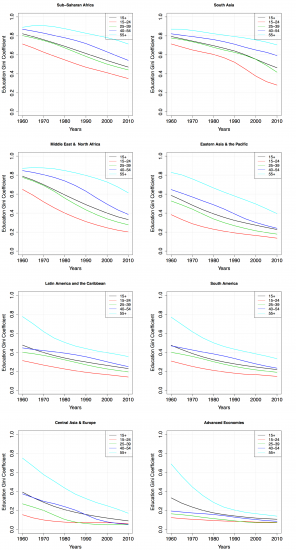
An important consequence of the global didactics expansion is a reduction in education inequality beyond the globe. The following visualization shows this through a series of graphs plotting changes in the Gini coefficient of the distribution of years of schooling across dissimilar earth regions. The Gini coefficient is a measure of inequality and higher values indicate higher inequality – you can read virtually the definition and estimation of Gini coefficients in our entry on income inequality. The time-serial nautical chart shows inequality by age grouping. It tin be seen that as inequality is falling over time, the level of inequality is higher for older generations than it is for younger generations. We tin can besides see that in the reference menses education inequality went down every twelvemonth, for all age groups and in all earth regions.
Have gains from historical education expansion fully materialized? The breakdown by historic period gives us a view into the future: as the inequality is lower among today's younger generations, we can look the reject of inequality to go along in the future. Thus, further reductions in educational activity inequality are still to exist expected within developing countries; and if the expansion of global education can exist continued, nosotros tin speed upwardly this of import procedure of global convergence.
Education Gini coefficients by world region for selected age groups, 1960- 2010 – Figure 4 in Crespo Cuaresma et al. (2013)13
Education inequality can decline rapidly across all levels of instruction – Republic of korea is an example
The experience of South korea shows that it is possible to reduce instruction inequality rapidly across all levels of education. The following visualization show two graphs comparing the concentration of years of education in South Korean between the years 1970 and 2010. To be precise, each of these graphs shows an education Lorenz curve: a plot showing the cumulative per centum of the schooling years beyond all levels of instruction on the vertical axis, and the cumulative per centum of the population on the horizontal axis. As information technology tin exist seen, in 2010 education was much less concentrated than in 1970, non merely considering there was a smaller share of individuals without schooling (shown along the lesser of the chart), but also because there was a smaller share of individuals concentrating big proportions of school-years at higher levels of educational activity. Indeed, in only 40 years Republic of korea was able to double the mean years of schooling (from 6 to 12 years) and at the same time get remarkably close to the 45-degree line marking the hypothetical scenario of perfect equality of schooling. In other entries we prove that in this same menstruum South Korea increased drastically its GDP per capita while significantly improving health outcomes, such every bit child mortality.
Inequality of Educational Attainment in S Korea 1970 and 201014

Financing of didactics across the world
The world is expanding funding for teaching today
The final ii decades have seen a small simply full general increase in the share of income that countries devote to educational activity. The following chart plots trends in public expenditure on education equally a share of Gdp. As usual, a choice of countries is shown by default, but other countries can be added past clicking on the relevant choice at the top of the nautical chart. Although the data is highly irregular due to missing observations for many countries – an issue we discuss in more than detail in our section on Data Quality below –, we can still observe a broad up trend for the majority of countries. Specifically, information technology can be checked that of the 88 countries with bachelor data for 2000/2010, three-fourths increased education spending as a share of Gross domestic product within this decade. As incomes – measured by GDP per capita – are generally increasing around the world, this means that the full amount of global resources spent on didactics is also increasing in accented terms.
You can explore the trends by education level in these interactive charts:
- Government expenditure on pre-main didactics as share of GDP
- Government expenditure on primary education as share of Gross domestic product
- Government expenditure on secondary education as share of GDP
- Government expenditure on tertiary education as share of Gdp
Is additional funding for education taking resources from other sectors?
The in a higher place-mentioned growth in overall government expenditure on educational activity as a share of GDP cannot be entirely attributed to a broad-spread alter in the prioritization of education spending within domestic budgets. The following visualization shows authorities expenditure on education as a share of total government expenditure. In this instance the available data does not advise a discernible global pattern. For instance, of the 36 countries with available data for 2000 to 2010, only around half increased spending on educational activity relative to the other sectors. The data does suggest, yet, that there is large and persistent cross-state heterogeneity in the relative importance of pedagogy vis-a-vis other sectors, even within developing countries. For example, in 2011 teaching accounted for nigh 8% of government spending in the Central African Democracy, while it accounted for about 30% in Ghana.
Mostly speaking, countries that spend a big share of their income on education also tend to prioritize education highly within their budgets. The post-obit visualization presents a snapshot of government spending on didactics effectually the world for the year 2016. Specifically, this graph plots government expenditure on education as a share of GDP in the vertical axis, and government expenditure on education every bit a share of total government expenditure in the horizontal axis. Each dot on this chart represents a different country, with the assigned colors cogent unlike world regions. Equally we can see, there is a positive correlation, merely regional differences are stark: for almost every level of spending as a share of Gross domestic product along the horizontal axis, European countries (marked in calorie-free orange) spend a smaller budget share on education.
In European countries the weight of chief education within total education spending is lower than in other countries
In comparing to countries where education started expanding later, European countries tend to assign relatively more of their authorities education budgets to the secondary and tertiary levels, while at the same time devoting relatively less of their general government budgets to education as a whole. This tin can exist appreciated in the following visualization, where the priorization of primary educational activity (i.due east. the share of primary education inside the teaching budget) is plotted against the overall priorization of education (i.due east. the share of education inside the entire authorities upkeep). Information technology tin can exist seen that European countries (marked once more in light orangish) are mostly located in the bottom-left. And there is a weak positive correlation between the variables, both across all countries and beyond European countries.15
The following visualization shows the percentage of total education expenditures contributed directly by households in 15 high income countries and 15 low/heart income countries (most recent data available on 2014). The top chart in this figure, corresponding to loftier income countries, shows a very clear pattern: households contribute the largest share of expenses in tertiary education, and the smallest share in master didactics. Roughly speaking, this pattern tends to be progressive, since students from wealthier households are more likely to attend third education, and those individuals who nourish 3rd pedagogy are likely to perceive large individual benefits (more on this in our entry on Skill Premium).16 In contrast, the lesser nautical chart shows a very different picture: in several low-income countries households contribute proportionally more to primary education than to higher levels. Republic of malaŵi is a notable case in point – tertiary teaching is most completely subsidised by the state, yet household contribute with almost 20% of the costs in primary educational activity. Such distribution of private household contributions to education is regressive.
Recent funding structures in OECD countries
Primary education continues to be publicly funded in industrialized countries
We have already mentioned that those countries that pioneered the expansion of main education in the 19th century – all of which are current OECD member states – relied heavily on public funding to do so. Today, public resources still boss funding for the primary, secondary and mail service-secondary not-third education levels in these countries. While in the concluding decade the share of public funding for these levels of didactics has decreased slightly, the broad blueprint is remarkably stable. The visualization presents OECD-average expenditure on pedagogy institutions by source of funds.17 By clicking on the option labeled 'relative' you can see the corresponding share of each source: private funding went upwards from 7.9% in 2000, to nine.4% in 2012. The office of public funding for other levels of education is however quite different. At the 3rd level public sources account for less than 70% of funding on average (2012 figures). Beneath we provide evidence of the pre-school level.
Publicly funded pre-primary education is more strongly developed in the European countries of the OECD
High-income countries tend to have better developed pre-primary education systems than lower-income countries. Even so, inside high-income countries there is substantial heterogeneity in the extent to which pre-primary instruction is publicly financed. The visualization presents expenditure on pre-primary educational institutions as a share of GDP beyond the OECD. As information technology can exist seen, publicly funded pre-primary education tends to exist more strongly adult in the European than the not-European countries of the OECD. In fact, the OECD reports that in Europe the concept of universal access to education for 3-half dozen year-olds is mostly accepted: most countries in this region provide all children with at least two years of free, publicly funded pre-primary education in schools before they brainstorm primary pedagogy.
Where does funding for didactics get to?
The largest office of funding devoted to education in OECD countries goes to finance current expenditures, mainly bounty of staff – specifically, teachers. The following ii charts, taken from the OECD's report Pedagogy at a Glance (2015), highlight the labour-intensive nature of educational activity. In the lower levels of didactics (i.e. primary, secondary and postal service-secondary non-3rd) the share of current expenditure is very large and exhibits little cross-country variation – between 90 and 97 percent of full expenditure corresponds to current expenditure beyond all of the OECD countries. In college levels of education (i.e. 3rd) there is more than cross-country variation, but current expenditure nevertheless dominates by a large margin beyond all countries.
What drives current expenditure on education?
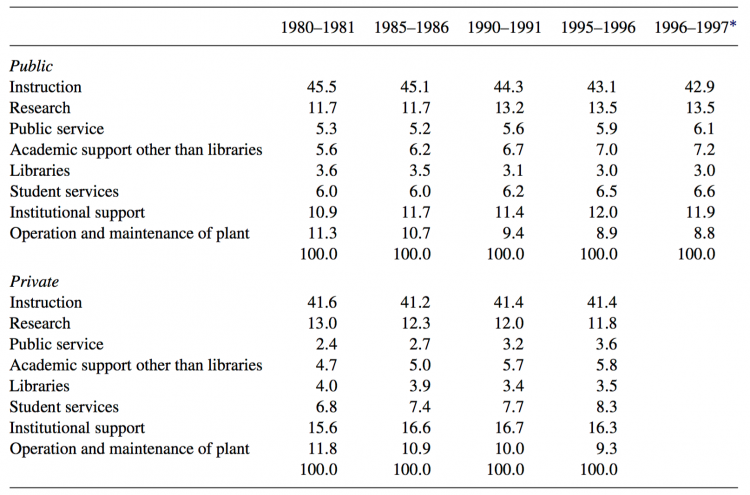
In the figures higher up we noted the importance of current expenditure in the production of education. The post-obit table provides further details regarding the type of expenditures that comprise current spending. Specifically, this chart shows a breakdown of expenditure for tertiary-level institutions in the The states (public and private), during the period 1980-1997. It shows that educational activity accounts for nearly one-half of expenditure; and while in that location are some modest differences across sectors, there is a fair amount of stability in expenditures across time. This serves equally a benchmark for lower didactics levels, where instruction takes an even larger share of expenditure.18
Percent distribution of college and academy current expenditures in the United states of america, by control over time – Table 8 in Welch and Hanushek (2006)19
International financing flows
Education financing in developing countries has been largely affected by development assistance
Following the understanding of the Millennium Development Goals, the get-go decade of the 21st century saw an important increase in international financial flows under the umbrella of development assistance (often too chosen development aid, or just 'aid'). The following chart shows total OECD development help flows for instruction by level, in constant 2013 US dollars, for the period 2002-2013. As it can be seen, there are two singled-out periods: in 2003-2010 flows for didactics increased substantially, more than than doubling in existent terms across all levels of education; and in the years 2010-2013 funding for basic education decreased, while funding for secondary and postal service-secondary education remained relatively abiding. For many depression income countries, where development assistance contributes a substantial share of funding for education, this marked modify in trends is important. As a reference, in 2012 development assistance deemed for more than than 20 percent of all domestic spending on basic educational activity in recipient low-income countries.20
The recent reductions in development assistance funds for principal education have been coupled with important changes in regional priorities. Specifically, the share of evolution help for main education going to sub-Saharan Africa has been decreasing sharply since the understanding of the Millennium Evolution Goals. The post-obit nautical chart shows this: sub-Saharan Africa'due south share in full help to primary education declined from 52 percent in 2002 to xxx percentage in 2013, while the continent's share in the full number of out-of-school children rose from 46 percent to 57 percent. This design is something specific to the education sector within the broader development assistance landscape: in the healthcare sector the overall slowdown of flows started a couple of years afterwards, was less abrupt, and afflicted proportionally less the sub-Saharan countries.21 Indeed, recent studies further highlight that development assist for education is significantly unlike to assistance for healthcare in other ways: the didactics sector attracts less earmarked funding through multilaterals, and includes a smaller proportion of resources that developing governments can directly command for programming.22
You lot tin can read more nearly development assistance for healthcare in our entry on Financing Healthcare.
Share of primary education disbursements from evolution assistance going to Sub-Saharan Africa, 2002-2013 – Figure 2.6 in Steer and Smith (2015)23

Development assistance priorities have a scope for increasing or reducing expenditure inequalities
In the Historical Perspective section above, we mentioned that public spending on educational activity has translated, in the long run, into lower inequality in education outcomes across most of the earth. But for any given state, with a determined income distribution and demographic structure, the extent to which public spending on education contributes to reduce inequality depends crucially on the way in which spending is focused across education levels. The recent UNICEF report The Investment Case for Education and Equity shows that in depression income countries, on boilerplate 46 percent of public resources are allocated to the ten percent of students who are most educated – while this effigy goes downwardly to 26 and 13 percent in lower-eye and upper-eye income countries respectively. The following visualization shows further details on the concentration of public spending across different countries. The vertical centrality shows the percentage of public education resources going to the 10% nearly educated or 10% least educated students – equally nosotros can run across expenditure is heavily concentrated at the peak in many low income countries.
The before remarks about trends in international education financing flows (namely that aid is very of import in low-income countries, and that a relatively low and shrinking share of help is going to chief levels), advise that inequality in public spending will worsen in depression income countries. Even so evolution assist priorities take a scope for changing this.24
What determines educational finance?
- The big pic
- Schoolhouse inputs
- Household inputs
The big moving-picture show
Why practice governments finance instruction?
One of the reasons to justify authorities intervention in the market for educational activity, is that education generates positive externalities.25 This essentially ways that investing in pedagogy yields both individual and social returns. Private returns to didactics include higher wages and ameliorate employment prospects (as nosotros discuss in our entry on Returns to Didactics). Social return include pro-social behaviour (e.g. volunteering, political participation) and interpersonal trust. The post-obit nautical chart uses OECD results from the Survey of Developed Skills to prove how cocky-reported trust in others correlates with educational attainment. More precisely, this nautical chart plots the per centum-point difference in the likelihood of reporting to trust others, past education level of respondents. Those individuals with upper secondary or postal service-secondary non-tertiary education are taken equally the reference group, and so the pct bespeak difference is expressed in relation to this group. Equally nosotros tin can come across, in all countries those individuals with tertiary instruction were past far the grouping most likely to report trusting others. And in nigh every country, those with post-secondary non-3rd education were more probable to trust others than those with chief or lower secondary education. The OECD'due south written report Education at a Glance (2015) provides similar descriptive evidence for other social outcomes. The conclusion is that adults with higher qualifications are more probable to report desirable social outcomes, including skilful or fantabulous health, participation in volunteer activities, interpersonal trust, and political efficacy. And these results hold after controlling for literacy, gender, age and monthly earnings.
Exercise countries that spend more public resources on education tend to take better pedagogy outcomes?
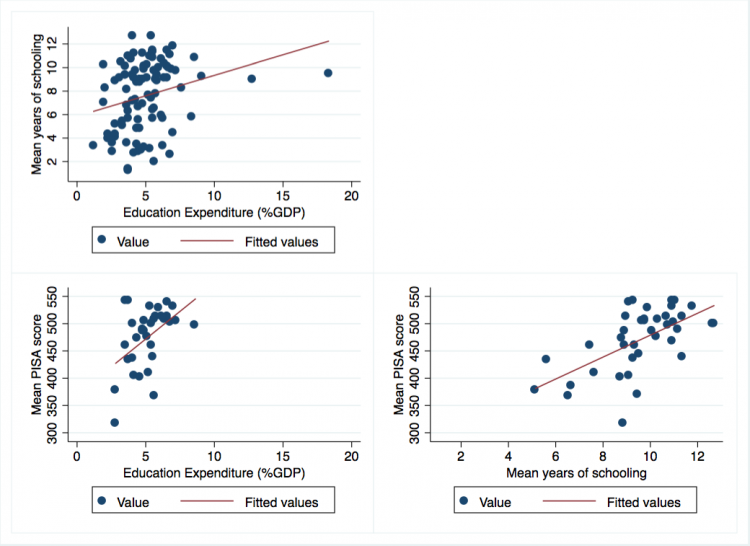
Education outcomes are typically measured via 'quantity' output (e.chiliad. years of schooling) and 'quality' output (e.g. learning outcomes, such equally test scores from the Program for International Student Assessment – PISA). The following visualization presents three scatter plots using 2010 data to show the cross-state correlation between (i) pedagogy expenditure (as a share of GDP), (ii) mean years of schooling, and (iii) mean PISA test scores. At a cross-sectional level, expenditure on education correlates positively with both quantity and quality measures; and not surprisingly, the quality and quantity measures too correlate positively with each-other. But manifestly correlation does not imply causation: there are many factors that simultaneously bear on educational activity spending and outcomes. Indeed, these scatterplots prove that despite the broad positive correlation, there is substantial dispersion away from the trend line – in other words, there is substantial variation in outcomes that does not seem to exist captured by differences in expenditure.
Correlation betwixt education outcomes and education expenditure (2010 information)27
Does cross-country variation in government teaching expenditure explicate cross-country differences in didactics outcomes?
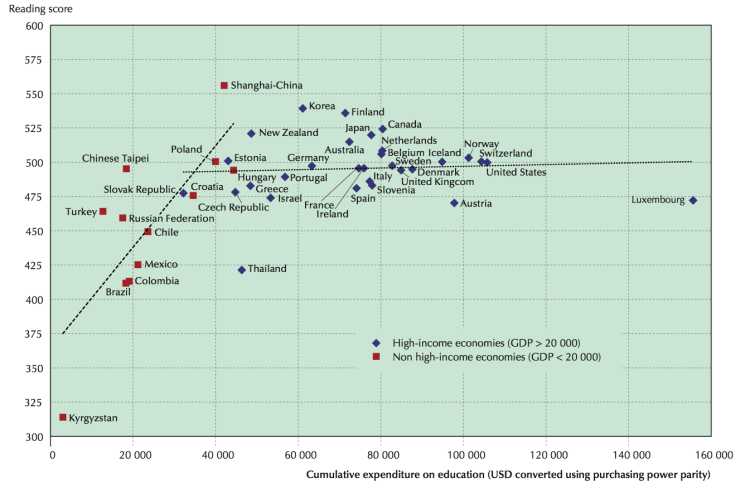
The following visualization presents the relationship between PISA reading outcomes and average educational activity spending per student, splitting the sample of countries by income levels. It shows that income is an important gene that affects both expenditure on education and pedagogy outcomes: nosotros can see that to a higher place a certain national income level, the relationship between PISA scores and educational activity expenditure per pupil becomes virtually inexistent. Several studies with more than sophisticated econometric models corroborate the fact that expenditure on instruction does not explain well cross-state differences in learning outcomes.28 You can read more nigh exam scores and learning outcomes in our entry on Quality of Instruction.
Average reading performance in PISA and average spending per pupil from the age of 6 to 15 – Effigy 1 in OECD (2012)29
What inputs enter the 'education product part'?
The fact that expenditure on didactics does not explain well cross-country differences in learning outcomes is indicative of the intricate nature of the process through which such outcomes are produced. Borrowing the terms from the economic science literature, the following 'production function' provides a conceptual framework to think about the determinants of learning outcomesxxx:
where A is skills learned (achievement), s is years of schooling, Q is a vector of school and teacher characteristics (quality), C is a vector of child characteristics (including "innate ability"), H is a vector of household characteristics, and I is a vector of schoolhouse inputs under the command of households, such every bit children's daily attendance, attempt in school and in doing homework, and purchases of schoolhouse supplies.
This conceptualization highlights that, for whatsoever given level of expenditure, the output achieved will depend on the input mix. And consequently, this implies that in club to explain education outcomes, nosotros must rely on information about specific inputs. In the post-obit sections nosotros explore bear witness regarding the returns to household inputs (i.e. unlike elements of Q) and demand-side inputs (i.due east. elements of C,H and I).
School inputs
Each teaching system is different, but improving teacher quality is oftentimes more than constructive to amend learning outcomes than increasing the number of teachers per pupil
A vast number of studies have tried to guess the impact of classroom resources on learning outcomes. The following tabular array summarizes results from the systematic review in Hanushek (2006)31. In this tabular array, the left-manus side summarizes results from econometric studies focusing on developing countries, while the right-hand side presents evidence from the US (where studies have concentrated extensively). We can see that for all listed inputs and across all countries, the share of studies that accept found a positive consequence is minor – in fact, the majority of studies find either no effect, or a negative result. This clearly does not mean that these classroom resources are not of import, but rather that it is very hard to know with confidence when and where they are a binding constraint to better learning outcomes. A offset decision, therefore, seems to exist that context and input mix are fundamental to improving outcomes – even in developing countries where the expected returns to additional resource is big across the board.
Taking the ratio of positive to negative effects detected in the literature as a proxy for what tends to work all-time, we can derive a 2nd determination from the table: spending more than resources on meliorate teachers (i.due east. improving teacher experience and teacher education) tends to work better to improve learning outcomes than simply increasing the number of teachers per student. And this seems to exist true both in developed and developing countries. This last conclusion is consequent with the main message from the OECD's report Does money buy strong performance in PISA?, which points out that countries that prioritised the quality of teachers over class sizes performed meliorate in PISA tests.32
And it is also consequent with a recent loftier-quality study on the impact of teacher quality on exam scores using data from the U.s.a., which suggests that improvements in teacher quality can causally raise students' exam scores (testify from Chetty et al. (2014)33 – see our entry on Quality of Education for a word of their results).
Percentage distribution of estimated effect of selected key resource on student performance – based on Tables 3 and 6 in Hanushek (2006)34

Remedial teaching can yield substantial improvements in learning outcomes
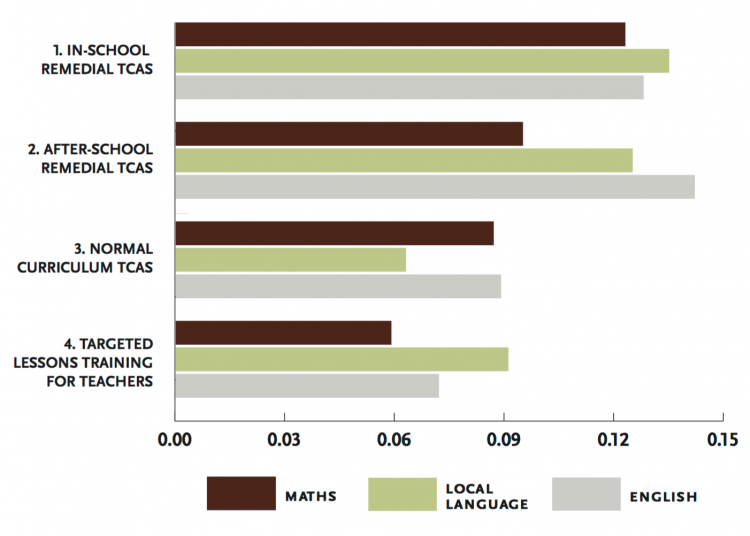
Education in low-income countries is especially difficult because in that location is substantial heterogeneity in the degree of preparation that children have when they enter school – much more than so than in high-income countries. Contempo evidence from policy 'experiments' in developing countries suggests remedial educational activity, in the class of assistants teaching targeted lessons to the lesser of the class, can yield substantial improvements in learning outcomes. The following visualization summarizes the effects of four dissimilar policy treatments within the then-called Teacher Community Banana Initiative (TCAI) in Ghana – this is an initiative that evaluated 4 different such remedial education interventions.35
The units in this figure are standard deviations of test results. The offset two sets of estimates correspond to the exam-score impacts of enabling community assistants to provide remedial educational activity specifically to depression-performing children, either during school, or after school. The third set of estimates corresponds to test-score impacts of providing a community assistant and reducing class size, without targeting instruction to low-performing pupils. And the terminal set of results corresponds to testing the issue of grooming teachers to provide small-group instruction targeted at pupils' bodily learning levels.
As nosotros can see, while all interventions had a positive effect, the everyman impacts – across all tests – come from the not-targeted 'normal curriculum' intervention that reduced class sizes, and from the intervention that provided training to teachers on how to appoint in targeted remedial teaching themselves. This suggests that the improvements in outcomes were caused by the combination of targeted instruction and TCAs who, unlike teachers, were specifically dedicated to this purpose. These results are consistent with findings from across Africa, suggesting that teaching at the right level causes better learning outcomes in a cost-effective way (see Glewwe and Muralidharan 201636 for further details on this show).
Summary of treatment furnishings from the Teacher Community Assistant Initiative (TCAI) in Ghana (estimates past exam subject field in standard deviations) – Folio 2 in Innovations for Poverty Action (2014)37
Are pay-for-functioning teacher contracts an effective instrument to amend learning outcomes?
We accept already fabricated the point that the bulk of pedagogy expenditure goes specifically towards financing teachers. And we accept also pointed out that improving teacher quality may exist a particularly good instrument to improve didactics outcomes. This leads to a natural question: are pay-for-performance teacher contracts an effective instrument to improve learning outcomes? A growing body of literature in the economics of instruction has started using randomized control trials (i.e. policy 'experiments') to answer this question. Glewwe and Muralidharan (2016)38 provide the following account of the bachelor evidence:
"Results suggest that even minor changes to compensation structures to reward teachers on the basis of objective measures of functioning (such as attendance or increases in student test scores) can generate substantial improvements in learning outcomes at a fraction of the toll of a "business as usual" expansion in education spending. However, not all performance pay programs are likely to exist effective, so it is quite important to design the bonus formulae well and to make sure that these designs reverberate insights from economic theory." 39
The conclusion is that well-designed pay-for-functioning contracts are a cost-effective instrument to boost test scores; just this does not mean that they are necessarily constructive at achieving other – perhaps equally important – objectives of time spent in schoolhouse. In simple words, information technology is possible that pay-for-functioning yields 'teaching to the test'. Alternative incentive mechanisms, such as community-based monitoring of teachers, have been proposed as an culling. Glewwe and Muralidharan (2016) also provide a review of the – somewhat limited – bachelor evidence on such alternative incentive mechanisms.40
Household inputs
School attendance and student effort are responsive to incentives
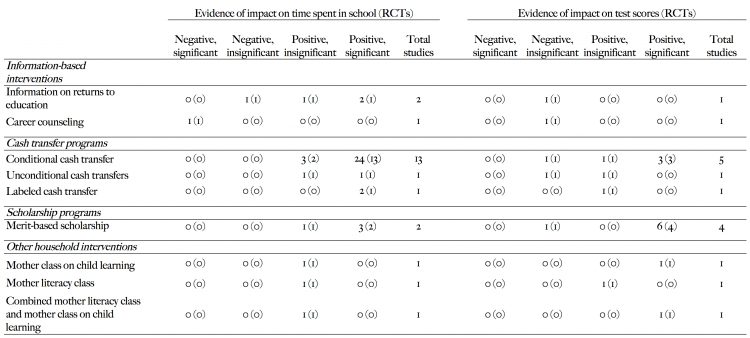
Need-side inputs are as important as supply-side inputs to produce education. Attending school and exerting effort are perhaps the well-nigh obvious examples: without these inputs fifty-fifty the best endowed schools will fail to deliver practiced outcomes. The table summarizes information on different demand-side investments that have shown to successfully improve quality and quantity outcomes. More than precisely, this table gathers show from randomized command trials in developing countries, as per the review in Glewwe and Muralidharan (2016). The reported figures correspond to positive/negative significant/insignificant estimates beyond a set of available experimental studies (comport in mind some studies gauge more than one effect – e.g. by measuring outcomes at several points in time). As we can see, the evidence suggests interventions that increment the benefits of attention school – such equally conditional cash transfers – are likely to increase student time in school. And those that increase the benefits of higher try and meliorate academic performance – such as merit scholarships – are likely to improve learning outcomes (see Glewwe and Muralidharan 2022 for further details on the underlying policy interventions, plus further evidence and discussion of results).
Summary of impacts for selected demand-side interventions on education outcomes in developing countries – based on Tables four and 5 from Glewwe and Muralidharan (2016)41
Targeting health problems tin be a specially cost-effective way of increasing school attendance
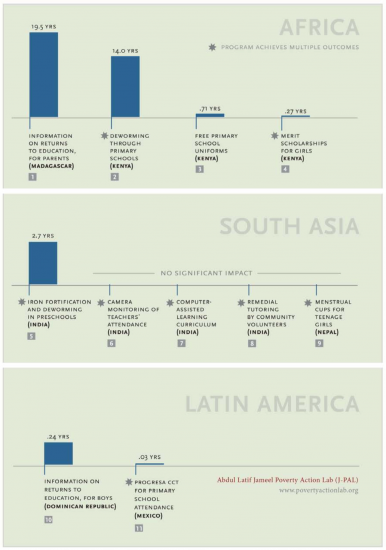
In many low-income countries, health bug are an of import factor preventing children from attending school. The post-obit visualization presents a comparison of the bear on that a number of different health interventions take accomplished in different countries – together with some non-health-related interventions that serve every bit reference. The acme of each bar in this graph reflects the additional schoolhouse years achieved per hundred dollars spent on the respective intervention; so these estimates can exist interpreted as a mensurate of how cost-effective the different interventions are.42
We see that treating children for intestinal worms (labeled 'deworming' in the chart) led to an additional thirteen.nine years of teaching for every $100 spent in Kenya; while a program targeting anaemia (labeled 'atomic number 26 fortification') led to 2.7 additional years per $100 in India. These interventions seem to be much more price-effective to improve test scores than conditional cash transfers, free school uniforms, or merit scholarships (further details on all interventions available from Dhaliwal et al. 201243). Of course, ranking these interventions is not footling since almost programmes attain multiple outcomes – indeed, we have already discussed that remedial teaching is generally effective to increase test-scores, although here we see a detail instance where it had no impact on school omnipresence. Nevertheless, health interventions seem to be particularly interesting, since they atomic number 82 to substantial achievements in both education and health outcomes (for a recent analysis of the literature on the impacts of mass deworming encounter Croke et al. 201644).
Impact of selected need-side interventions on school participation in developing countries (Additional years of student participation per $100) – Figure 8.1 in Dhaliwal et al. (2012)45
How important are pre-schoolhouse investments?
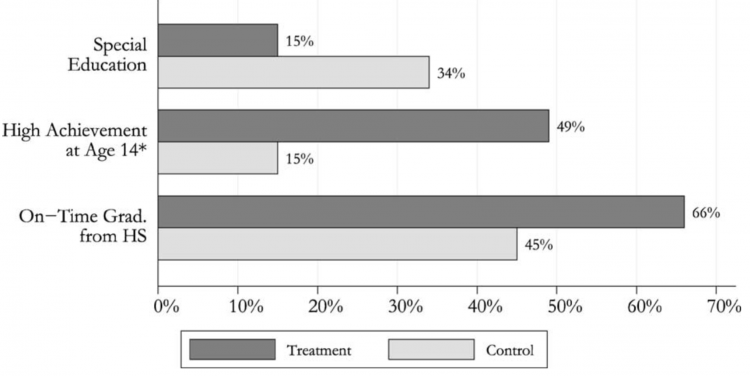
The surround that children are exposed to early in life, plays a crucial office in shaping their abilities, beliefs and talents. To a great extent, this is what drives large and remarkably persistent gaps in the educational activity achievement between individuals in the aforementioned country, but in unlike socioeconomic environments. Cunha et al. (2006) provide a detailed account of the theory and evidence behind this claim, and discuss its implications for the design of education policies. In the chart we see the impacts from the Perry Preschool Program – a flagship experimental intervention study, designed to test the impact of pre-school education on subsequent education outcomes.46 The chart shows disadvantaged children participating in the pre-school programme (the 'treatment group') had higher grades and were more likely to graduate from high school than the reference command grouping. Moreover, they spent substantially less time in special education. Other programs have similarly shown testify of very large and persistent returns to early didactics interventions.
Educational effects from participating in the Perry Preschool Program – Figure 14B in Cunha et al (2006)47
Relationship between sources
The principal source of data on international education expenditure is UNESCO's Institute for Statistics (UIS). The same information is likewise and then published past the World Bank (Globe Bank EdStats and World Development Indicators) and Gapminder. It is also the master source of education data for near UN reports – such as the EFA Global Monitoring Report (UNESCO), the Human Development Study (UNDP), the Land of the World's Children report (UNICEF) and the Millennium Development Goals (UN).
The UIS database is produced mainly from yearly national reports, only it also relies on reports from international organizations.48
Specifically, countries in the European Wedlock, or members of the OECD, have richer data, since they collect information through the UIS-OECD-Eurostat (UOE) survey, which is more detailed than the UIS survey (run into more at FAQ-UIS)
Another, related but unlike source of education expenditure data, is the International Food Policy Research Institute (IFPRI), which publishes the Statistics of Public Expenditure for Economical Evolution (SPEED). This source relies primarily on information from the International Monetary Fund (IMF).
Definitions
In the UIS database, regime expenditure on education includes spending by local/municipal, regional and national governments, on public and private educational institutions, education administration, and subsidies for private entities (students/households and other privates entities). This data is so reported by level of education, and typically as a share of national income (GDP) or as a share of total public expenditure. In principle, expenditure on pre-primary levels as well as expenditure sourced with transfers from international sources to regime, are included. In exercise, however, many countries under report these specific figures.
Measurement limitations
The UIS has been maintained since 1999 with the intent of providing comparable expenditure figures beyond countries and time, and its estimates rely on reports submitted by ministries and national statistics offices. Since reporting is delegated typically to ministries of education, in some instances data on total public expenditure on education fails to stand for spending past other ministries that besides have budgets for education. Additionally, since not all countries accept (or update) national education accounts, the UIS attempts to generate estimates and impute missing data using information from national publications, official websites and other sources. However, the UIS dataset has several missing observations, particularly for years prior to 2010.
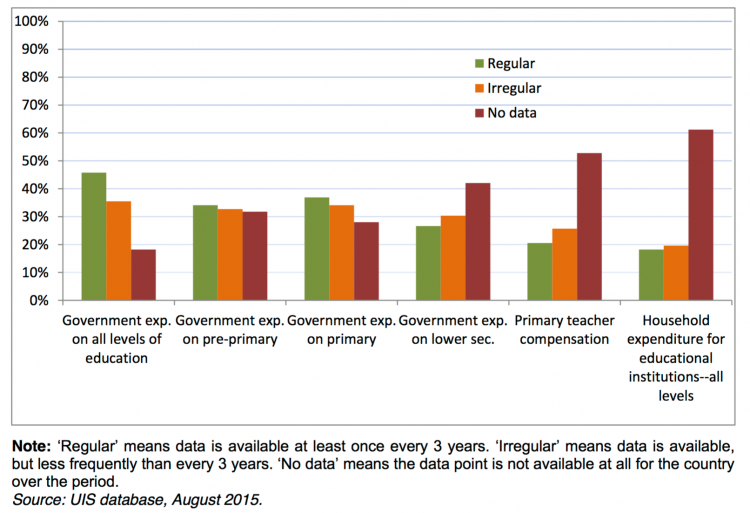
To gauge the extent to which UIS data is reliable, the following visualization shows the proportions of regular and irregular data that countries brand available (where 'Regular' means information is available at least one time every 3 years; and 'Irregular' ways data is available less oft than every three years). Every bit can be seen, the picture is not particularly encouraging: less than one-half of the countries reported regularly data on full government expenditure on education over the reference period.
Apart from the in a higher place-mentioned bug regarding availability of information, international cross-state comparisons of education financing estimates are also problematic due to lack of consistency in classification of expenditures, peculiarly on the borderline of instruction services. While this is less problematic than in other sectors, such as healthcare, at that place are still some difficult cases – such as classifying expenditure for teaching hospitals, or expenditure on ancillary services such as transportation. For a farther discussion of these problems encounter the UIS data collection manual .
Availability of teaching financing data in the UIS database, 2005-2013, equally a per centum of all (214) countries – Figure 1 in UNESCO–UIS (2016)49
Long-run estimates of educational activity financing
Every bit it has been mentioned, the earliest data on financing of pedagogy dates back to the belatedly 19th century, when today's industrialized countries began expanding their pedagogy systems. The main sources here are academic publications.
Lindert (1994)
- Data Source: Lindert, Peter H. "The ascension of social spending, 1880-1930." Explorations in Economic History 31, no. 1 (1994)
- Clarification of available measures: Public Education Expenditure every bit percent of GDP
- Time span: Selected years in the late 19th century
- Geographical coverage: Option of high-income countries
Flora et al. (1983)
- Data Source: Flora, Peter et al. 1983. State, Economy and Society in Western Europe, 1815-1975. Frankfurt: Campus Verlag
- Clarification of available measures: Central authorities expenditure by sectors, as per centum of Gdp and as percentage of total expenditure.
- Fourth dimension bridge: 1815-1975
- Geographical coverage: Western Europe
- Link: Bachelor online from http://gpih.ucdavis.edu/Government.htm/
Tanzi and Schuknecht (2000)
- Information Source: Tanzi, Vito, and Ludger Schuknecht. Public spending in the 20th century: A global perspective. Cambridge Academy Press, 2000.
- Description of bachelor measures:
- Public Health Expenditure as percent of Gross domestic product
- Health Insurance Coverage every bit percent of labour strength
- Time span: 1910-1994
- Geographical coverage: Selection of loftier-income countries
Szirmai (2015)
- Data publisher: Adam Szirmai, (2015) The Dynamics of Socio-Economic Evolution, www.dynamicsofdevelopment.com
- Information source: Different sources, but mainly UIS after 2000, and selected UNESCO yearbooks prior 2000
- Description of available measures:
- Gross enrolment ratios by educational level, country and region
- Net enrolment ratios by region
- Highest diploma obtained (as percentage of 25+ age bracket)
- Average years of education of the population of 25 years and over
- Regime expenditure per pupil in selected countries, 1965-2010
- Regime expenditure on education as a percentage of gross national product
- Cognitive performance of developing countries
- Illiterates equally a Percentage of the Population of xv years and over
- Time span: Selected years in the 2nd half of 20th century (periodic updates online)
- Geographical coverage: Selected low and heart income countries
Long-run land-specific statistics on teaching financing
Country-specific statistics are some other important source of long-run information on teaching spending. Two references we used in this entry are the U.South. Agency of the Demography and the U.S. National Centre for Education Statistics.
U.S. Agency of the Demography
- Information Source: (a) Historical Statistics of the United states Colonial Times to 1970 (1929-1970); and (b) US Demography Statistical Abstract 1990 (1970-1990). Both published by the US Bureau of the Demography
- Clarification of available measures: Total education expenditure, disaggregated past private and public spending, with further details on specific types of expenditure (figures mainly expressed in current prices)
- Fourth dimension span: 1929-1990
- Geographical coverage: U.S.
National Eye for Educational activity Statistics
- Information Source: National Heart for Pedagogy Statistics (NCES) – Digest of Education Statistics
- Clarification of bachelor measures: Data on a variety of subjects in the field of pedagogy statistics, including the number of schools and colleges, teachers, enrollments, and graduates, in addition to educational attainment, finances, federal funds for education, libraries, and international education.
- Time span: Since 1970
- Geographical coverage: U.Southward.
Up-to-date estimates of education systems (including education finances)
UNESCO – UIS Database
- Information Source: UIS based on reports from ministries, national statistics offices and international agencies
- Description of available measures:
- Out-of-school children
- Entry
- Participation
- Progression
- Completion
- Literacy
- Educational attainment
- International student mobility in tertiary education
- Human being resources
- Fiscal resources
- School resource and didactics weather (Africa merely)
- Adult education (Latin America and the Caribbean but)
- Disparities in instructor's training, deployment, characteristics and working conditions at sub-national level (East and Due south W Asia merely)
- Fourth dimension span: 1970-2015 for some variables, only well-nigh variables available since 1998
- Geographical coverage: Global by Country
- Link: http://information.uis.unesco.org
Another important source is the OECD – this is arguably the most comprehensive database in terms of variables and regularity of observations. This is the source used for the OECD'southward periodic report Teaching at a Glance.
OECD Teaching Statistics
- Information Source: OECD based on reports from member countries
- Description of available measures:
- Graduation and entry rates
- Graduates and entrants by field
- Profile of graduates and entrants
- Educatee-teacher ratio and boilerplate class size
- Distribution of teachers by age and gender
- Enrolment rate by historic period
- Share of enrolment by type of institution
- Share of enrolment by gender, programme orientation and manner of report
- Share of international students enrolled by field of education
- Share of international students enrolled by country of origin
- Transition from schoolhouse to piece of work
- Educational attainment and labour-force condition
- Educational finance indicators
- Time bridge: 1960-2015 for some variables, though substantial missing values prior 1990
- Geographical coverage: OECD countries
- Link: http://stats.oecd.org
Yet some other relevant source of internationally comparable expenditure statistics is IFPRI's Statistics of Public Expenditure for Economical Evolution. This dataset relies mainly on Imf statistics.
IFPRI – SPEED
- Data Source: IFPRI, from multiple dats sources, but mainly International monetary fund statistics
- Description of available measures:
- Didactics expenditure in 2005 $ppp
- Teaching expenditure in 2005 United states$
- percentage of education expenditure in full gdp
- per capita instruction expenditure in 2005 $ppp
- pct of didactics expendtiure in full expenditure
- Time span: 1980-2012
- Geographical coverage: 67 countries across all continents
- Link: https://www.ifpri.org/publication/statistics-public-expenditures-economic-evolution-speed
Source: https://ourworldindata.org/financing-education
0 Response to "Correlation Vs Causation Reading for Middle School Students"
Post a Comment